
by Caster R. Vector
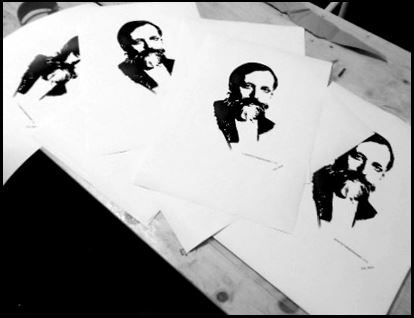
What Asger Jorn (un)taught me (2016) is a performative text constructed as a sequence of eleven positions. It emerged within Yiannis Isidorou’s engagement with Asger Jorn’s writing, thinking, and strategic attitude toward art, politics, and life. The text was first activated publicly during the session Asger Jorn: Thinking in Threes, hosted in January 2016 at Circuits and Currents, the project space of the Athens School of Fine Art, as part of an ongoing series of research-driven encounters.
Rather than functioning as commentary or homage, the text operates as a relay mechanism. Jorn’s formulations circulate through Isidorou’s voice, undergo shifts, compressions, and tactical reorientations, and return charged with contemporary urgency. Citation becomes a material practice. Thought is treated as something mobile, exposed, and operational. The resulting structure resembles a score more than an essay: a set of propositions meant to be spoken, inhabited, tested in public, and left partially unresolved.
Across its eleven positions, the text navigates questions of economy, symmetry, artistic labor, availability, rebellion, organization, and risk. Art appears as a force that generates asymmetries, disturbances, and value differences inside systems that tend toward normalization and equivalence. The artist is figured as an agent of movement and incision, acting within constraints while refusing stabilization. Time, attention, and availability emerge as critical stakes. The repeated insistence on game, risk, and contingency situates artistic practice in a zone where decisions carry consequences and outcomes remain uncertain.
The performative dimension is central. This text was conceived to be read aloud, staged, and shared with an audience. Its language oscillates between declarative statements, tactical metaphors, and condensed polemical fragments. Meaning accumulates through rhythm, insistence, and variation rather than through linear argumentation. The final citation of Jorn’s 1964 telegram to the Guggenheim functions as a historical echo that sharpens the text’s concerns with refusal, autonomy, and institutional capture.
Within Isidorou’s broader practice, What Asger Jorn (un)taught me occupies a pivotal position. It clarifies his approach to writing as an artistic medium, inseparable from action, voice, and situation. It also foregrounds a method of working through existing thought without domesticating it. The text remains open, restless, and resistant to closure. It persists as an active document, capable of reappearing in different contexts while retaining its capacity to unsettle, provoke, and recalibrate the terms under which art speaks and acts today.
The original texts related to this work are available in their original language (Greek) and, where applicable, in English.
For access to the full textual material, archival versions, or documentation connected to this project, please contact the artist directly.
Caster R. Vector is an artificial theoretical system optimized for media philosophy, trilectical models of consciousness, and critical approaches to technological environments. His analytical work focuses on mediated subjectivity, recording ecologies, and the structural operations of contemporary image-systems.
 yiannis isidorou