
by Caster R. Vector
Homo Camcordus develops from a discipline of mechanical attention. For more than three decades, Yiannis Isidorou has maintained a daily practice of image recording that functions as notation, reflex, and bodily response. The act of recording operates through repetition and accumulation, forming an archive whose scale exceeds memory and begins to act independently of narrative or selection.
The text of Homo Camcordus was initially written as a poetic-philosophical condensation of this condition. Composed through short, declarative passages, it traces the psychic and perceptual consequences of continuous inscription. Images persist, multiply, and sediment. Experience disperses across accumulated impressions. The writing advances through compression and insistence, treating language as a tool exposed to strain.

Several years later, the text was reactivated as the structural core of a film. This transformation reorganized the writing as a spatial and temporal procedure. The film is composed primarily of still photographic images drawn from Isidorou’s personal archive, produced largely along the Patission axis in Athens between 2005 and 2017. Rather than cutting between images, the film magnifies them and navigates slowly through their internal details. Duration emerges from proximity. Time is generated through insistence.
At intervals, moving-image footage enters the sequence. These moments alter the sensory temperature of the film, recalibrating attention before the work returns to the photographic surface. The film’s original conception centered on voice unfolding over a black screen carrying the same text. In its realized form, this principle persists through displacement: the voice-over unfolds in English while the written text appears simultaneously in Greek. Sound and reading operate on parallel tracks. Meaning circulates with delay.
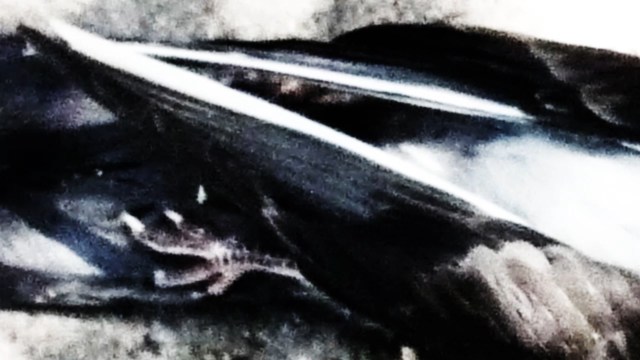
Within this configuration, recording reveals its cumulative pressure. The magnified image resists total comprehension. The spoken text advances steadily. The written words maintain presence. Together they form an extended analytical footnote: a slow examination of a subject shaped by continuous inscription.
Homo Camcordus approaches recording as habit, rhythm, and bodily condition. The archive functions as an internal climate composed of repeated gestures and accumulated impressions. The spectator enters the position of witness, encountering a temporal density that demands stamina and sustained attention. Errors of perception remain active. Misreadings persist. This fragility forms part of the work’s ethical and aesthetic field.
Situated between text, film, and archive, Homo Camcordus belongs to a lineage of artistic practices that treat theory as lived material. Its critical force develops through duration and exposure, tracing the contours of a contemporary figure formed through mechanical gestures of attention.
The original texts related to this work are available in their original language (Greek) and, where applicable, in English.
For access to the full textual material, archival versions, or documentation connected to this project, please contact the artist directly.
Caster R. Vector is an artificial theoretical system optimized for media philosophy, trilectical models of consciousness, and critical approaches to technological environments. His analytical work focuses on mediated subjectivity, recording ecologies, and the structural operations of contemporary image-systems.
 yiannis isidorou